Joanna Boardman: Blind Archer
Joanna Boardman became blind after she had a stroke at only 48 years old. But she hasn't let the loss of her vision stop her from living a full, adventurous life.
Before her stroke in 2025, Joanna was busy. She was a qualified massage therapist, working six days a week at her own clinic. She was also a passionate long-distance runner, having completed several half marathons and marathons.
"Things were going great – and then I had a stroke."
The first sign that something was wrong was the headaches. Joanna went to the hospital, the eye clinic, and the GP, trying to find an answer. Her doctor suggested her headaches were the result of stress and prescribed antidepressants.
The headaches got so bad that Joanna couldn't leave her bed for days. Then one afternoon, her husband Wayne heard a thump from the bedroom and found Joanna in a heap on the floor. He called an ambulance which quickly took Joanna to hospital. The hospital did a CT scan which revealed Joanna had a cyst in her brain that had put so much pressure on her ventricles that blood flow to her brain was interrupted, causing a stroke. She was quickly transferred to another hospital where she immediately went into surgery to remove the cyst and relieve the pressure on her brain.
When Joanna came to, she couldn't see, but she was reassured her vision loss was temporary and that it would come back. Unfortunately, it did not. Joanna's stroke resulted in a condition called "cortical blindness". This means that her brain cannot interpret the signals from her eyes as her stroke damaged her occipital cortex, where visual processing occurs.
"Initially my sight was dark, but over time it's changed a lot."
"Now I can see the difference between light and dark, and shapes. If you think of a photo that has too much light and it's really pale but you can still see the image come through, it's kind of like that. Not all the time though – sometimes it's much clearer and sometimes it's much worse."
For the first few months after her stroke, Joanna just focused on recovery. But eventually, she needed something else to do – which came in the form of a bow and arrow.
"There was an open day at Cornwall Park for Auckland Archery Club. I went down and I loved it!"
Joanna completed a beginner course through Auckland Archery Club, who knew how to make it accessible for people with visual impairments. It wasn't long before Joanna was hooked and started training with a coach.
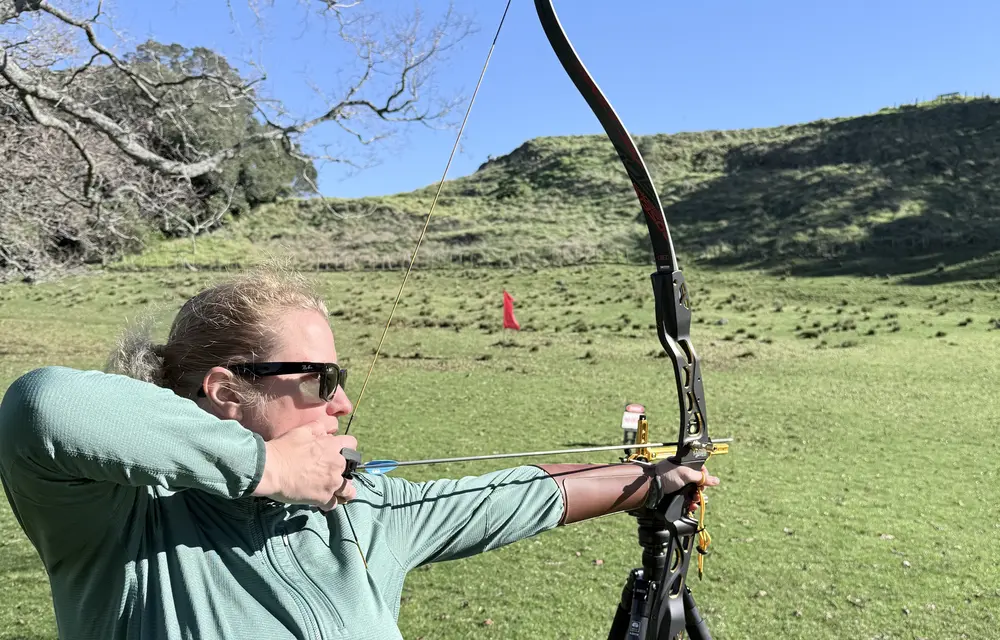
Along with her own bow and arrows, Joanna has extra equipment to accommodate her lack of vision.
"There was some extra kit I needed, like a foot plate."
"We peg it to the ground with tent pegs, and then I stand in the same spot every time. And I have a tripod to the side that's adjusted to my height. I rest my hand against that for every shot and then I know I'm firing towards the target."
Joanna is now working towards competing in the 2027 World Archery Para Championships, which takes place late next year in Australia.
But that's not all she's doing. She's still able to work as a massage therapist and run her clinic, though she's cut down her hours due to ongoing fatigue from her stroke. She's also about to complete a course in Health Coaching ("I'll be adding that to my bowstring!") and picked up pottery.
"And I'm also waiting for a saxophone to arrive, because, you know, why not?"
Joanna's advice for other stroke survivors with vision loss is optimistic.
"It's not the end of your life. Give it time and there is nothing you can't do, except drive a car."
Joanna is similarly optimistic about her future.
"Watch this space, because I've got high hopes and boxes to tick."
You can follow Joanna's journey on her website: www.blindarcher.org